
If you’ve ever waved a brightly coloured toy in front of your cat and wondered whether they see it the same way you do, you’re not alone. One of the most common questions pet owners ask is: what colours can cats see?
The answer is fascinating. Cats don’t see the world in black and white, but they also don’t experience the full rainbow of colours that humans enjoy. Instead, their vision has evolved to make them exceptional hunters, especially in low-light conditions.
In this guide, we’ll explain exactly what colours cats can see, which colours they struggle to distinguish, and how understanding feline vision can help you choose better toys, bedding, and accessories for your cat.
Can Cats See Colour?
Yes! Contrary to an old myth, cats can definitely see colours.
For many years, people believed cats only saw shades of grey. Modern scientific research has proven this isn’t true. Cats have colour vision, but it is more limited than that of humans.
The difference comes down to the types of light-sensitive cells inside the retina.
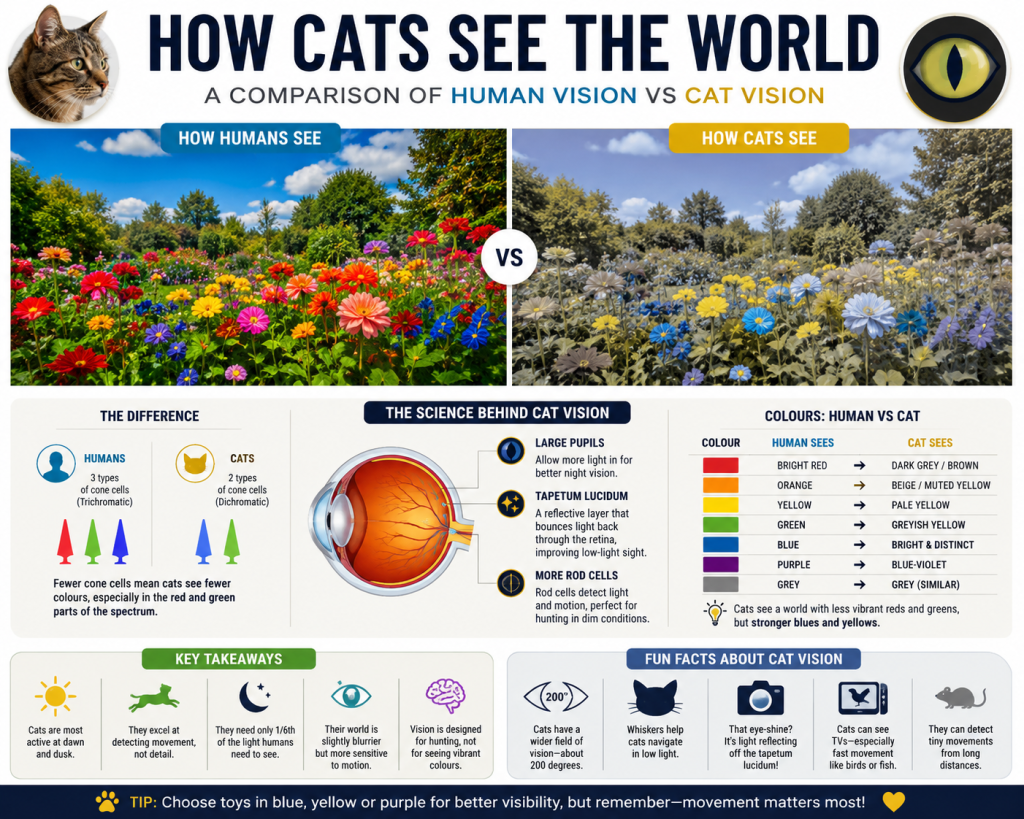
Humans have three types of cone cells, allowing us to detect red, green, and blue wavelengths. Cats have only two main types of cone cells, meaning they perceive a smaller range of colours.
What Colours Can Cats See Best?
Cats see certain colours much more clearly than others.
The colours cats are believed to see best include:
- Blue
- Blue-violet
- Grey
- Yellow (although less vibrant than humans see it)
These colours stand out most clearly to your cat and are easiest for them to distinguish.
This is one reason many cat toys are made in shades of blue or yellow—they’re simply easier for cats to notice.
What Colours Do Cats Have Trouble Seeing?
Cats struggle to distinguish colours in the red and green part of the spectrum.
Colours that may appear very similar include:
- Red
- Green
- Orange
- Brown
Instead of seeing bright reds and greens, cats often perceive these colours as muted shades of grey, beige, or brownish-yellow.
This means a bright red toy may not appear exciting to your cat simply because they don’t perceive its colour the way you do.
The infographic below illustrates the main differences between human and feline vision, including the colours cats can distinguish, why they excel in low light, and how their eyesight has evolved for hunting.
Is Cat Vision Similar to Colour Blindness?
In many ways, yes.
Experts often compare feline colour vision to a person with red-green colour blindness.
That doesn’t mean cats are colour blind—they simply have difficulty separating certain colours from one another.
For example:
| Human Colour | How a Cat May See It |
|---|---|
| Bright Red | Dark grey or brown |
| Green | Greyish-yellow |
| Orange | Beige or muted yellow |
| Blue | Bright and distinct |
| Yellow | Noticeable but softer |
Why Did Cats Evolve This Way?
Cats evolved as predators, not artists.
Their eyesight prioritises detecting:
- Movement
- Contrast
- Shadows
- Low light
Rather than needing to identify colourful flowers or fruit, wild cats needed to spot tiny movements from prey during dawn and dusk.
This explains why cats have:
- Excellent night vision
- Superb motion detection
- Wider peripheral vision than humans
- Reduced colour perception
Their vision is perfectly designed for hunting mice, birds, and insects.
Can Cats See in Complete Darkness?
No.
Another common myth is that cats can see perfectly in complete darkness.
In reality, no animal can see without any light at all.
However, cats need only around one-sixth of the light that humans require.
Their eyes contain:
- A large number of rod cells for low-light vision
- Large pupils that gather more light
- A reflective layer called the tapetum lucidum, which bounces light back through the retina
This is also why your cat’s eyes seem to glow when caught in headlights or a camera flash.
Do Cats See Better Than Humans?
It depends on the situation.
Cats are better at:
- Seeing in dim light
- Detecting movement
- Spotting prey
- Peripheral vision
Humans are better at:
- Seeing fine detail
- Reading
- Seeing distant objects clearly
- Distinguishing colours
A cat’s world is slightly blurrier but far more sensitive to movement.
What Colour Toys Do Cats Prefer?
If you’re shopping for a new toy, colour can make a difference.
The best colours for cat toys include:
- Blue
- Yellow
- Purple
- White (because of strong contrast)
While colour helps, movement is far more important.
A simple blue feather toy that moves unpredictably will usually be far more exciting than a bright red toy sitting still.
Can Older Cats See Colours Differently?
As cats age, their eyesight can change.
Older cats may experience:
- Cloudier lenses
- Reduced colour perception
- Lower contrast sensitivity
If your senior cat seems less interested in colourful toys, it’s often because movement and scent become more important than colour.
Interesting Facts About Cat Vision
Here are some surprising facts about feline eyesight:
- Cats have a field of vision of around 200 degrees, compared with approximately 180 degrees for humans.
- Cats can detect incredibly small movements from long distances.
- They are naturally most active at dawn and dusk when their vision performs best.
- Their eyes are optimised for hunting rather than recognising vibrant colours.
- Whiskers also help cats navigate in low light, complementing their eyesight.
Frequently Asked Questions
Can cats see blue?
Yes. Blue is one of the easiest colours for cats to distinguish and is believed to appear quite vivid to them.
Can cats see red?
Not in the way humans do. Red usually appears as a dull grey or brownish shade.
Can cats see green?
Cats have difficulty distinguishing green and often perceive it as a muted yellow-grey colour.
Can cats see television?
Yes. Modern high-refresh-rate televisions display movement smoothly enough for cats to follow, which is why many enjoy watching birds, fish, or insects on screen.
Final Thoughts
So, what colours can cats see?
Cats primarily see shades of blue, yellow, and grey, while reds, greens, and oranges appear much less distinct. Although their colour vision is limited compared with ours, they more than make up for it with exceptional night vision and remarkable sensitivity to movement.
Understanding how your cat sees the world can help you choose toys, create an enriching environment, and appreciate just how perfectly adapted feline vision is for life as a natural hunter.
Whether you’re buying a new scratching post, interactive toy, or cosy bed, remember that movement, contrast, and scent are usually far more important to your cat than bright colours. By keeping their unique eyesight in mind, you can make choices that keep your feline friend happier, healthier, and more engaged every day.
Leave a Reply